
Lost Love
A short film about loneliness — no words, only the sounds of the world around her.
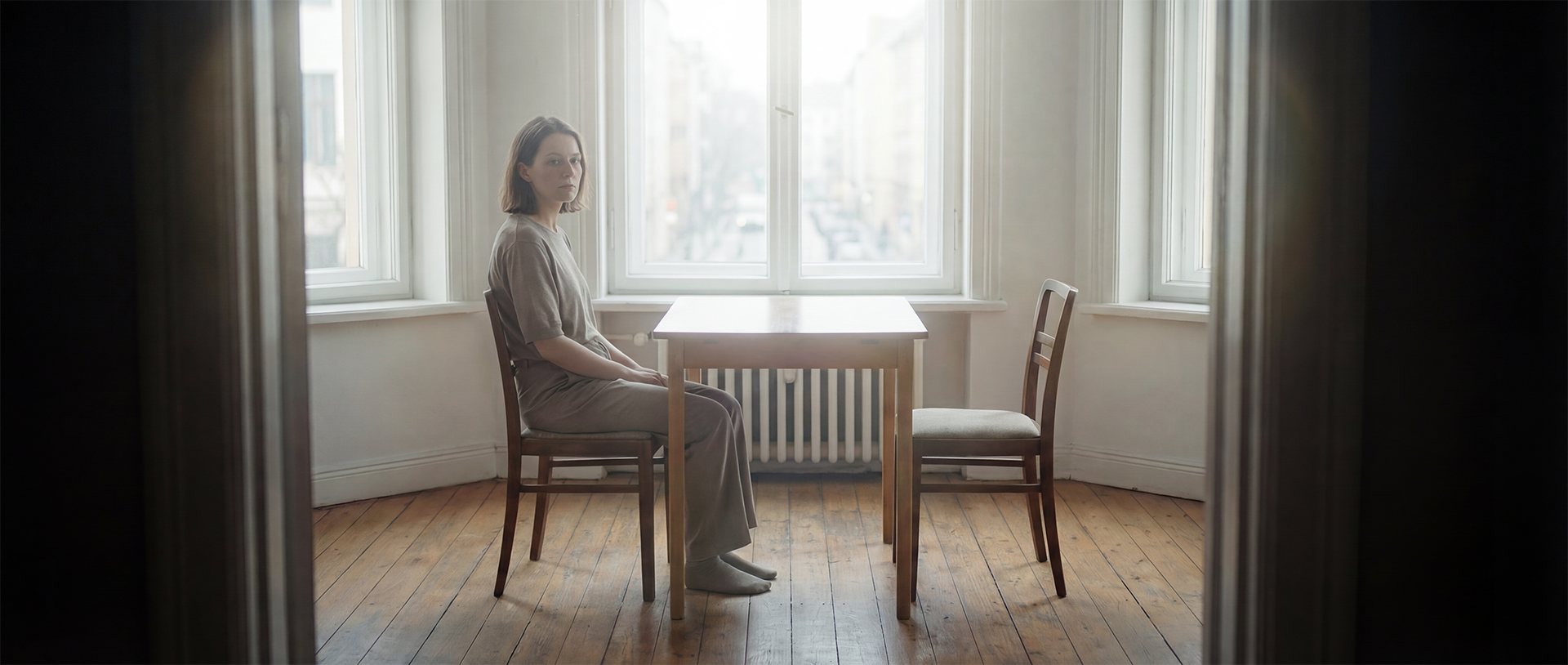
It opens on a woman at a small table set for two. One chair is empty. A door closes somewhere off-screen — and we understand, without a word, that she is alone.
She moves through the quiet rituals of a solitary life. She washes a single cup. She makes toast she doesn't want, sitting in another room, pushing the plate away as the small domestic act collapses under the weight of what's missing. The film follows her outward: waiting at an empty bus stop, crouching at the edge of a lake as if folding under something she can't name. A soft, distant shot of a man and the woman on a park bench — but he is turned away. She rises, and walks. And then she is back where she began: the room, the table, the two chairs, the one that stays empty.
There is no dialogue, and no score. The film is carried entirely on environmental sound — the run of a tap, the scrape of a chair, the wind off the lake, the silence of a room with one person in it. It's a deliberate choice, and a demanding one: with no words to explain her and no music to cue the feeling, everything rests on the images and the world's own quiet. The emotion has nowhere to hide.
This is the hard kind of film to make in AI — not the spectacle kind, the still kind. One woman, recognisably the same across every shot, carrying one unbroken mood through a dozen different spaces. Working in Runway, the real craft was continuity and tone — holding her face, her presence, her loneliness consistent from the kitchen to the lakeside, and trusting small things to carry the whole film: a single cup, an untouched plate, a back turned on a park bench. Loneliness isn't dramatic. The discipline was resisting the urge to explain it.